|
 Up
Up
 Wright Flyer II
(You are here.)

  Need
to Need
to
find your
bearings?
Try
these
navigation aids:
If
this is your first
visit, please stop by:
Something
to share?
Please:
|
|
Available in Française, Español, Português, Deutsch, Россию,
中文,
日本, and others.
 sing
no parts from Flyer I, the Wrights built a biplane slightly heavier than their
first (780 lbs or 354 kg). They beefed up the landing skids and
other parts of the airframe to make the Flyer more robust. They also decreased the
wing camber from 1:20 to 1:25. This was the only plane they ever
made with such a shallow camber. But for all aeronautical purposes,
the second Flyer was an identical copy of the first. sing
no parts from Flyer I, the Wrights built a biplane slightly heavier than their
first (780 lbs or 354 kg). They beefed up the landing skids and
other parts of the airframe to make the Flyer more robust. They also decreased the
wing camber from 1:20 to 1:25. This was the only plane they ever
made with such a shallow camber. But for all aeronautical purposes,
the second Flyer was an identical copy of the first.
The Wrights
knew that they had not tested the Flyer I design sufficiently to
make significant changes. But the Flyer II was also a test bed and
it did not remain a copy for long. The Wright brothers added
extensions to the skids to keep the wings and propellers clear of
the ground. They moved the engine backward and then forward to
adjust the center of gravity. The attached iron bars to the skids
under the elevator to further adjust the center of gravity. They
moved the radiator to the rear, then added a second radiator in the
front to aid in cooling the engine. They changed the shape of the
vertical rudder, increased the capacity of the gas tank, lengthened
the propellers and changed their shape.
During
23 May to 1 Dec 1904, the Wrights attempted to fly or flew a total of 105 times at Huffman
Prairie, eight miles east of Dayton, OH. Without the high winds of Kitty Hawk, the Wrights
had great difficulty launching the Flyer, although they were able to make a
few flights that covered up to 1432 feet (436 meters). Beginning 7 Sep 1904, Wrights used
catapult to launch plane in calm wind. This "catapult" was actually a
wooden derrick, 20 feet (6 meters) high, which dropped a 1200-1400 pound
(544-726 kg) weight. The weight was
attached to a rope, which ran through a compound (double) pulley at the top
of the derrick and a simple pulley attached to the weight. From there, it ran
down to the ground and 65-75 feet (20-23
meters) horizontally under the launching rail, through another
simple pulley, and
back to a tow bar attached to the btton front wing. The Flyer rest on a
wheeled trolley or "truck" so it could roll along the rail. When the weight
was released it fell just 16-1/2 feet (5 meters), but owing to the
compound pulley arrangement, it pulled the Flyer three times further
-- 49-1/2 feet (15 meters). As the weight fell, the Flyer
accelerated much faster than it would have with the thrust of the
propellers alone. The falling weight produced hundreds of
foot-pounds of additional thrust for the first few seconds of the
launch.
The Wright made 105 flights in 1904, racking up 45 minutes in total flight time.
In this airplane on 20 September, they made the first complete 360-degree
turn in an aircraft. The
two best flights (9 Nov and 1 Dec) exceeded 5 minutes and covered about 3 miles
(4.8 kilometers). During the 9 November flight, they circled the field
almost four times.
Over the winter of 1904-1905, the brothers built a third machine, the
Wright Flyer III, recycling the mechanical parts of the Flyer II. The wooden
parts were burned in 1905.
References:
|
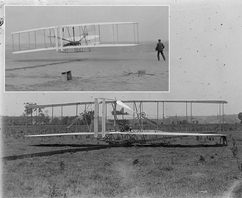
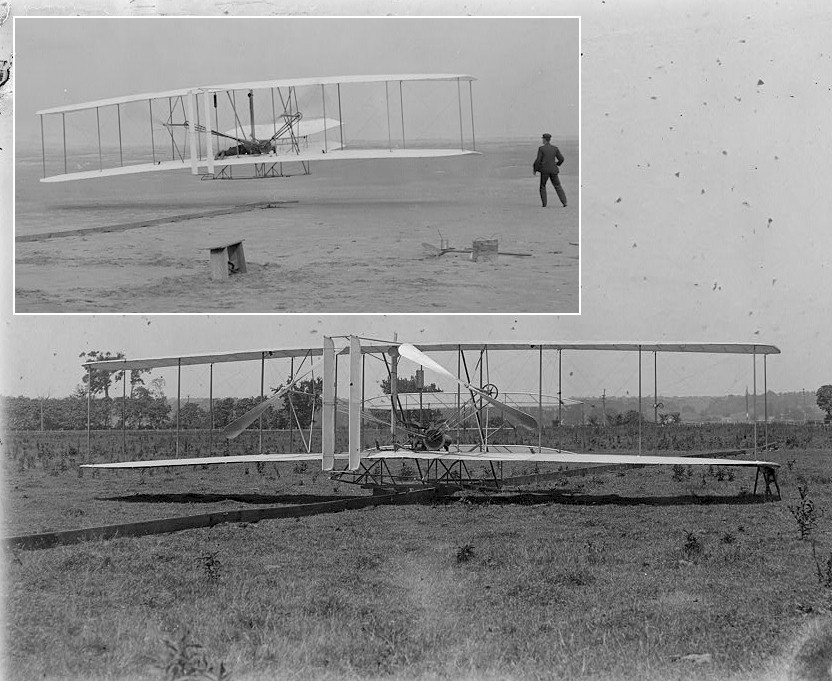
The 1904 Wright Flyer II was almost identical to the 1903 Flyer I,
as you can see by comparing these two photos.
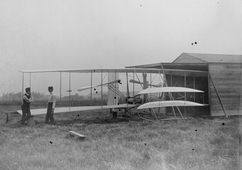
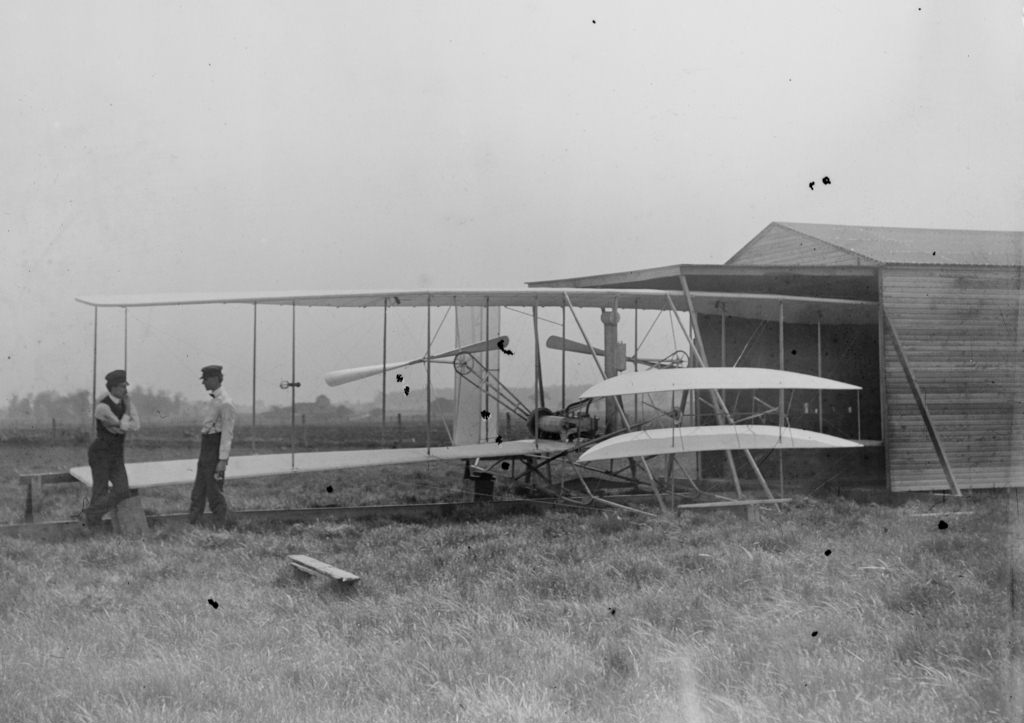
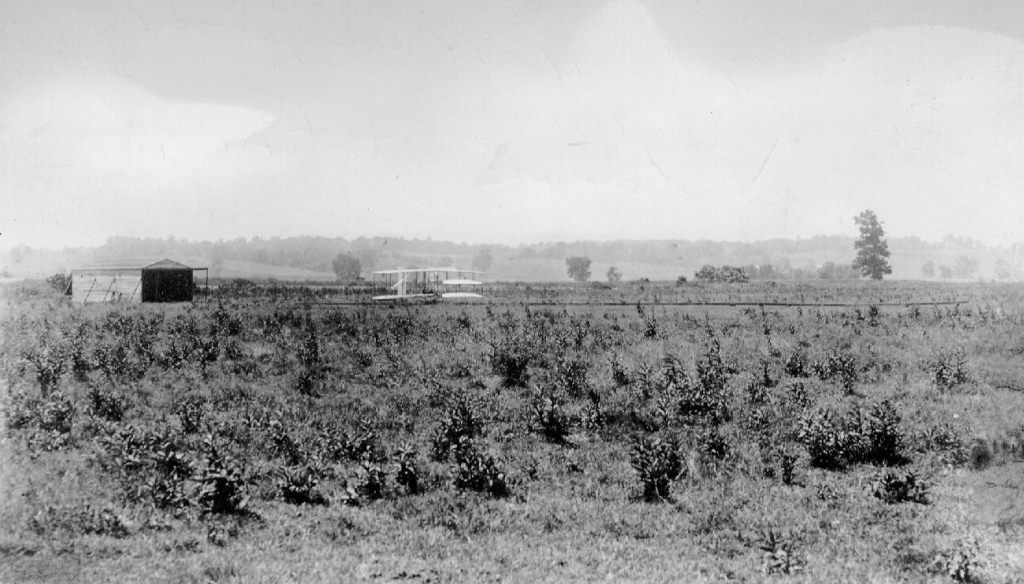
The Flyer II was hangared in a small shed the brothers built on the
prairie. The brothers removed the front elevator and the rear
rudder, then slid the aircraft into the shed.
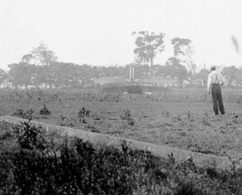
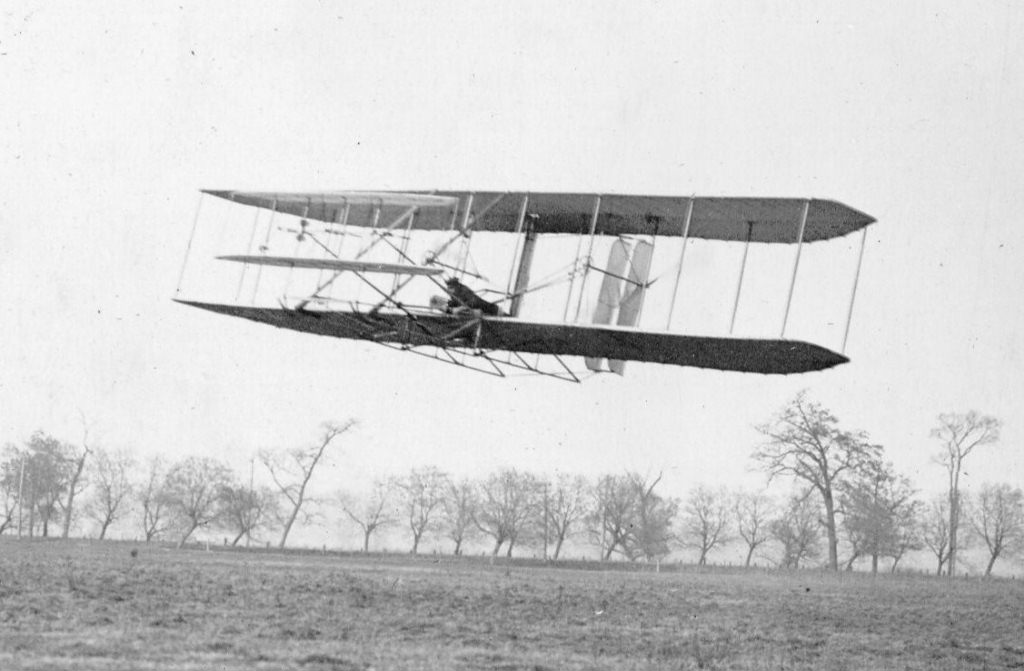
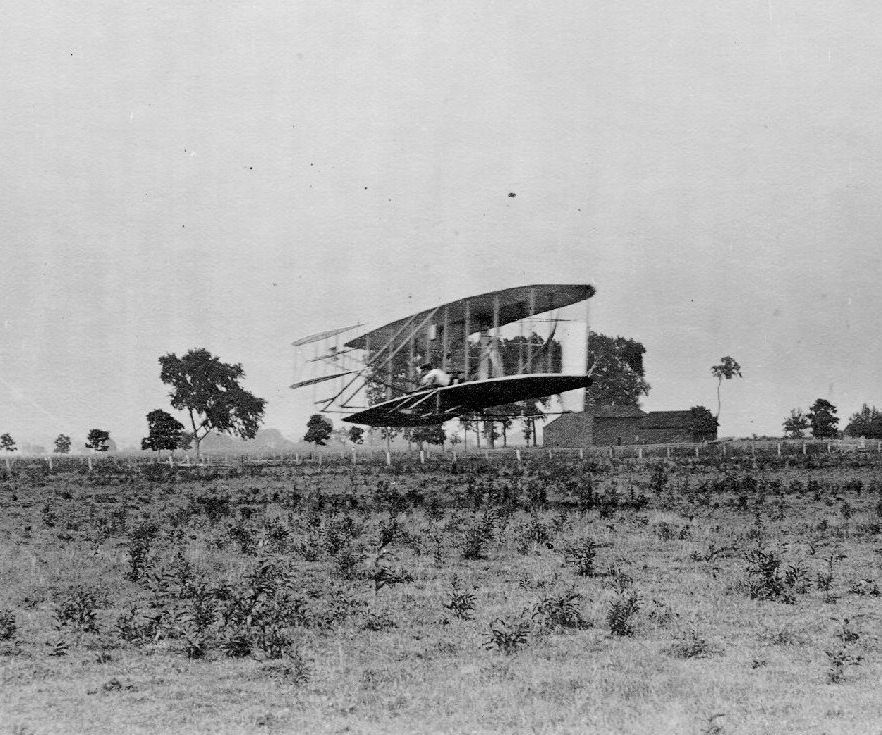
When flying in ground effect, the air is not moving over the control
surfaces as fast as it would be in flight at higher altitudes, so
the controls are "mushy." Additionally, the
Flyer II was an unstable
aircraft, especially in pitch -- the nose had a tendency to hunt up
or down. With the aircraft close to the ground, the control surfaces
not as effective as they might be, and the pitch of the aircraft in
constant need of control input, many early flights ended like this.
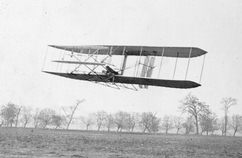
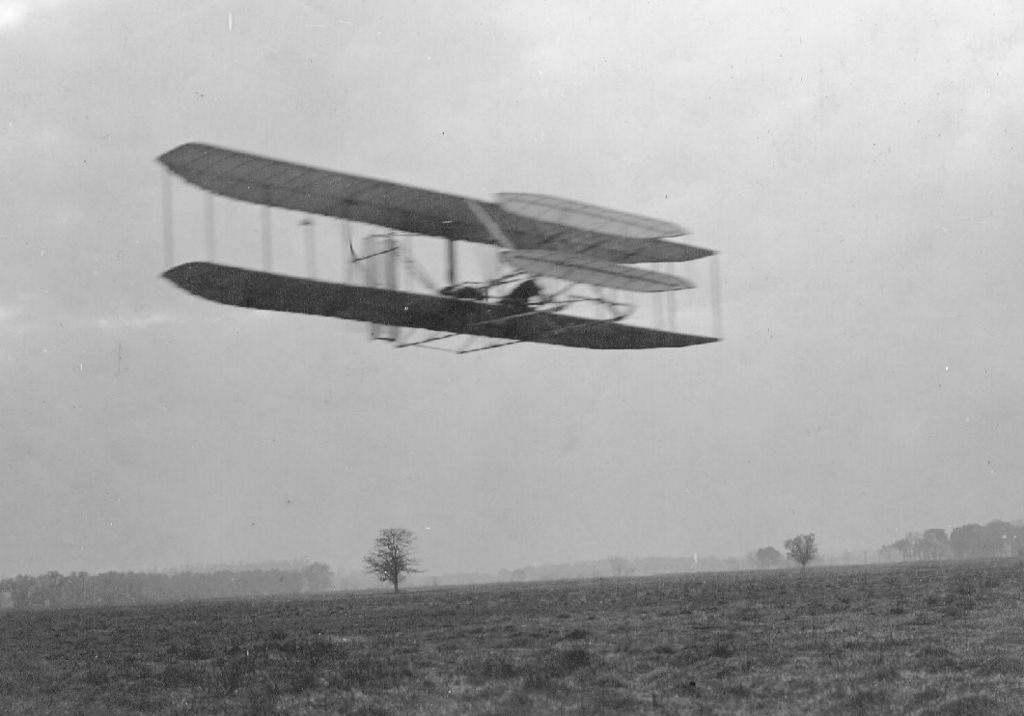
With the addition of the catapult, they began to make longer flights
at higher altitudes
and crashed less often. Note that the radiator is mounted on a rear
strut.
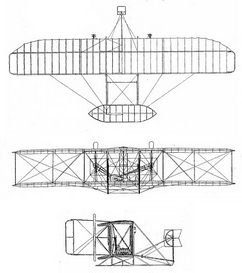
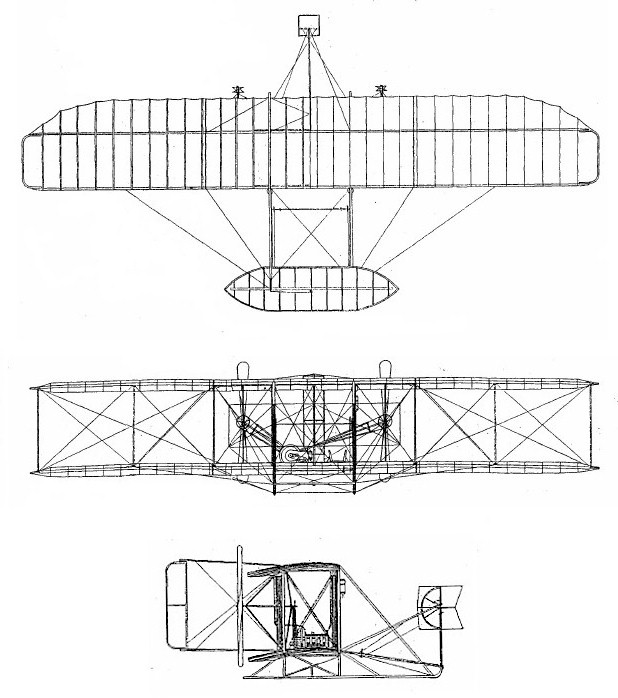
Top, front, and side views of the 1904 Wright Flyer II.
|
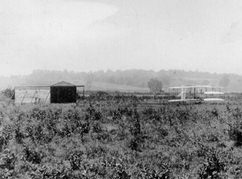
The Wright brothers tested the Flyer II at Huffman Prairie, a
pasture about eight miles (13 kilometers) northeast of Dayton, Ohio
and the present site of Wright-Paterson Air Force Base.
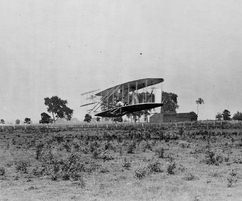
During their earliest flights in the
Flyer II, with little wind
to help achieve flying speed, the Wrights took off in "ground
effect" where the air is compressed between the wings and the
ground. This phenomenon allows flight at lower speeds than would be
possible at higher altitudes.
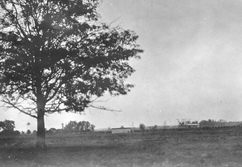
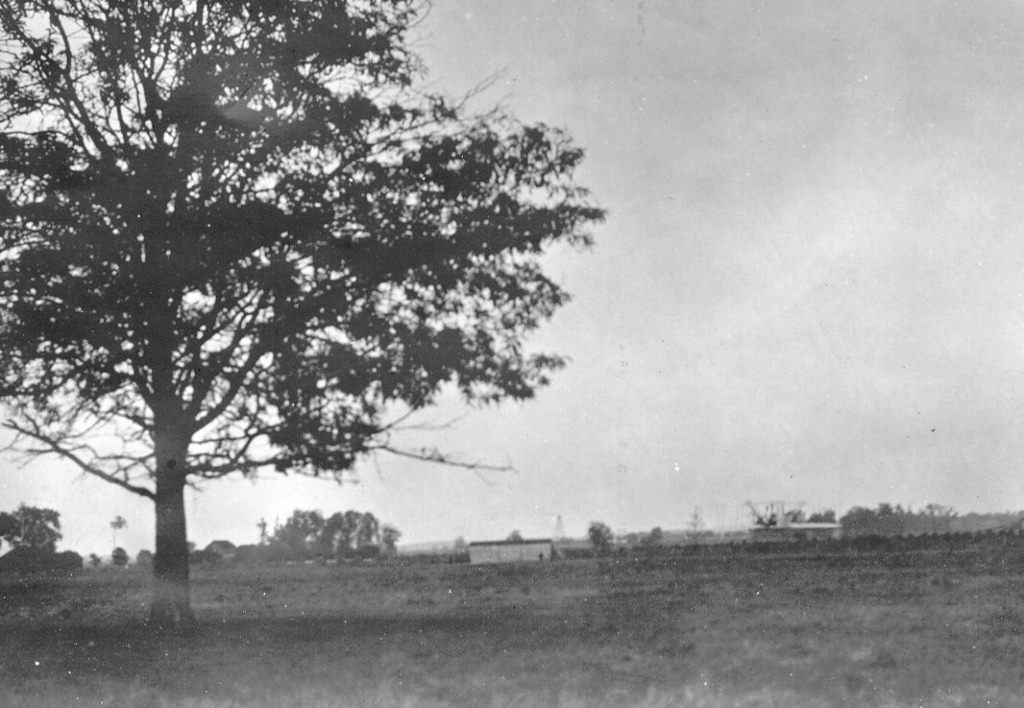
After a frustrating summer trying to get off the ground and out of
ground effect, the Wrights
built a catapult to help accelerate the Flyer II
during launch. (You can just see the outline of the catapult tower
to the right of the hangar). With the catapult, the Flyer could be
accelerated to 29 miles per hour (47 kph) before it reached the end
of the rail. Wilbur calculated flying speed to be "27 to 28" mph (43
to 45 kph).
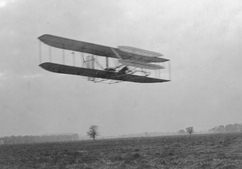
The best flight of the year was on 9 November 1904 when they flew
four circuits of the prairie, covering 3 miles or 4.8 kilometers.
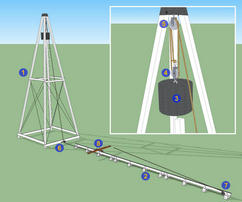
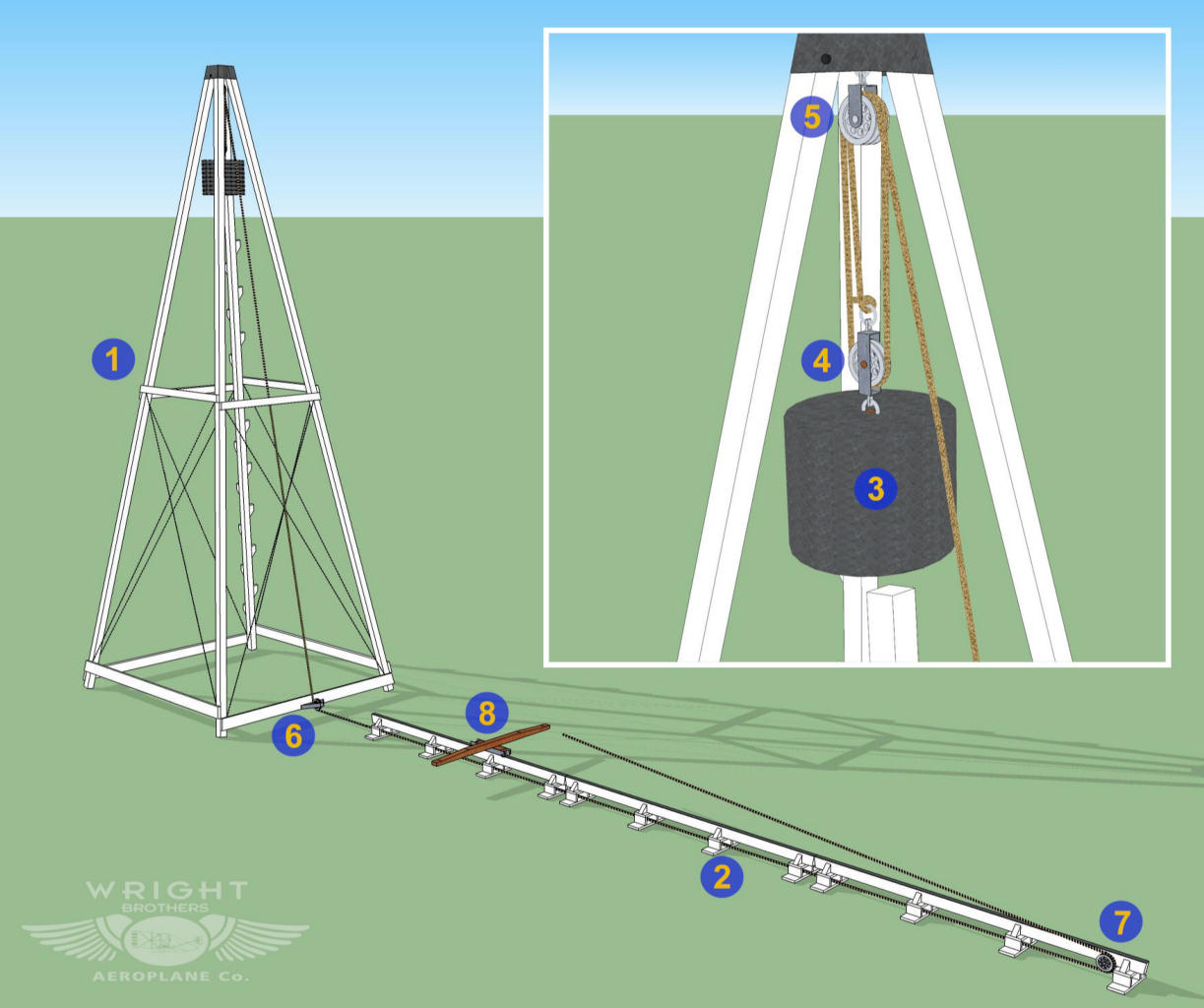
The Wright launching catapult consisted of a derrick (1) and a
launching rail (2). The derrick suspended a heavy weight (3) about
20 feet (6 meters) above the ground. A rope ran from a simple pulley
(4) at the top of the weight through a compound pulley (5) at the
top of the derrick, then down through the simple pulley and back up
through the compound pulley. From there it ran down to a simple
pulley (6) at the bottom of the derrick, then under the rail to
another simple pulley (7) about 65-75 feet (20-23 meters) out along
the rail. From there, it ran back to a hook on a tow bar at the front of the
airplane (not shown). The airplane rested on a two-wheel truck (8)
which rested on the rail. When the weight dropped, the rope pulled
the airplane and the truck along the rail. As the airplane took off,
the rope slipped off the tow bar hook and the truck ran off the rail's end.
For more information about the Wright catapult, including an
interactive 3D illustration,
click HERE.
|