|
 Up
Up
 Wright Timeline 1930
to 1939
Wright Timeline 1930
to 1939 
(You
are here.)

  Need
to Need
to
find your
bearings?
Try
these
navigation aids:
If
this is your first
visit, please stop by:
Something
to share?
Please:
|
|
Available in Française, Español, Português, Deutsch, Россию,
中文,
日本, and others.
 o
invention, no scientific discovery, no work of art, no human
endeavor happens in an historical vacuum. There are always other
factors -- cultural, political, personal -- that influence the
outcome of a single event. So it was with the invention of the
airplane. When Wilbur and Orville were children, the abacus was the most
advanced mathematical aid, influenza was an often-fatal disease, and
the cannon was the most feared weapon of war. By the time Orville
died, the first computers were just being built, antibiotics had
begun to wipe out disease, and the atomic bomb made war
unthinkable. Many of these advances influenced the development of
the airplane -- and the airplane, in turn, influenced further
advances. o
invention, no scientific discovery, no work of art, no human
endeavor happens in an historical vacuum. There are always other
factors -- cultural, political, personal -- that influence the
outcome of a single event. So it was with the invention of the
airplane. When Wilbur and Orville were children, the abacus was the most
advanced mathematical aid, influenza was an often-fatal disease, and
the cannon was the most feared weapon of war. By the time Orville
died, the first computers were just being built, antibiotics had
begun to wipe out disease, and the atomic bomb made war
unthinkable. Many of these advances influenced the development of
the airplane -- and the airplane, in turn, influenced further
advances.
Here is chronology that shows not just the story of the Wright
brothers, but also the world they lived in and the important political,
cultural, and scientific events that loomed large in their lives. Click on the
decade you want to see:
|
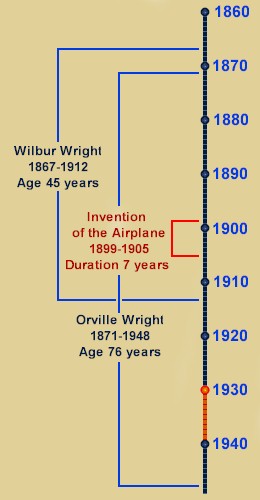 |
Note: For a detailed timeline that shows just the seven
years (1899 to 1905) in which the Wright brothers invented the
airplane, click
HERE.
|
Time
|
The Wright
Story
|
The Bigger
Picture
|
|
1930 |
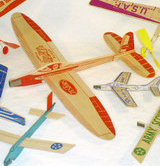
John McMahon publishes The Wright Brothers: Fathers of
Flight, the first biography of Wilbur and Orville
Wright. Orville invents a printing press that prints on
balsa wood and cuts out shapes. It's used to manufacture toy
airplanes.
|
 |
Astronomer C. W. Tombaugh
discovers the planet Pluto (later to be downgraded to a "planetoid").
|
 |
|
1931 |
NBC radio stations pay special
tribute to Orville on the occasion of his 60th birthday.
|
 |
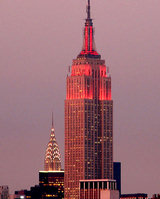
Ernest Lawrence invents the
cyclotron to study atomic particles, the Star Spangled
Banner becomes America's national anthem, and the Empire
State Building is completed in New York City.
|
 |
|
1932 |
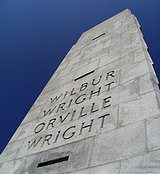
The Wright
Brothers Monument at Kitty Hawk, North Carolina is dedicated
with Orville Wright in attendance. Orville is the only
person to see a national monument erected to him while he
is still living.
|
 |
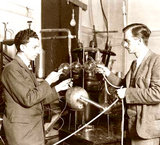
In England, Ernest Walton and
John Cockcroft "split the atom" for the first
time, using a proton beam to break lithium atoms apart into
helium atoms. |
 |
|
1933 |
Working with Chrysler engineer
Bill Earnshaw, Orville tests automobile shapes in his wind tunnel.
These lead to the first aerodynamic automobiles, the
Desoto Airflow and Chrysler Airflow.
|
 |
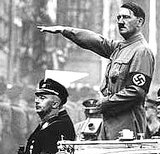
Adolph Hitler becomes Chancellor of Germany
and the Nazi party comes to power. Franklin Roosevelt
institutes the "New Deal" to lift America out of the Great
Depression.
|
 |
|
1934 |
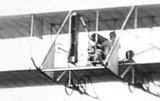
Marshall Reid flies a restored
Wright Model B belonging to the Franklin Institute from
Central Airport near Philadelphia. It is the last recorded
flight of an original Wright aircraft.
|
 |
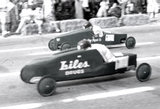
The Soap Box Derby begins in
Orville's home town of Dayton, Ohio.
|
 |
|
1935 |
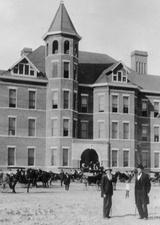
Orville receives an honorary
Doctor of Laws degree from Huntington College in Indiana, a
United Brethren institution. Huntington had evolved out of
Hartville College where his father Milton taught and where
his mother Susan had attended. |
 |
President Roosevelt signs the
Social Security Act, Parkers Brothers release the
Monopoly board game, and Howard Hughes sets an aviation
speed record of 352 mph in the Hughes H-1.
|
 |
|
1936 |
Henry Ford removes the Wright
bicycle shop and the Wright home from Dayton, Ohio to his
museum in Dearborn, Michigan. In return, Orville gets a
promise from Ford and the Early Birds of Aviation (who
brokered the deal) to support Orville in his dispute with
the Smithsonian.
|
 |
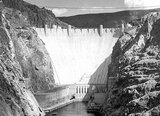
Hoover Dam, the world's largest
concrete structure, is completed.
|
 |
|
1937 |
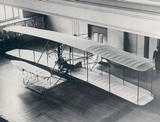
Orville prepares his Last Will
and Testament, deeding the 1903 Wright Flyer to the
Kensington Museum in England unless the will is amended at a
later date.
|
 |
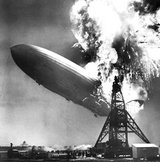
Amelia Earhart is lost while attempting to become the
first woman to fly around the world. The Hindenburg dirigible
explodes in New Jersey after crossing the Atlantic.
|
 |
|
1938 |
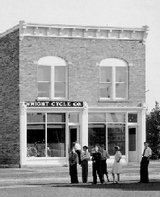
The Wright Bicycle Shop
and Wright home are opened to the public at Henry Ford Museum/Greenfield
Village. Orville and much of his extended family attend the dedication in
Dearborn, Michigan.
|
 |
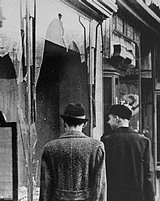
Nazi Germany invades Austria
and Czechoslovakia. The Holocaust begins with the "Kristallnacht"
(Night of Broken Glass) as Nazis destroy 7500 Jewish
businesses and hundreds of synagogues. Nylon is used for the
first time in a commercial product
– a toothbrush
|
 |
|
1939 |
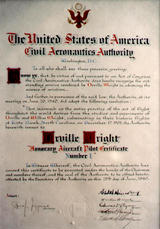
By Congressional decree, the Civil Aeronautics Authority
(the forerunner of the FAA) issues Honorary Pilot's License
No. 1 to Orville Wright.
|
 |
World War II begins in Europe and the Far
East. John Steinbeck writes The Grapes of Wrath and
Albert Einstein writes to U.S. President Roosevelt, advising
him of the possibility of creating a nuclear bomb.
|
 |
|
|
|
|


