|
 Up
Up
 1900 Wright
Glider 
(You are here.)

  Need
to Need
to
find your
bearings?
Try
these
navigation aids:
If
this is your first
visit, please stop by:
Something
to share?
Please:
|
|
Available in Française, Español, Português, Deutsch, Россию,
中文,
日本, and others.
 ecause
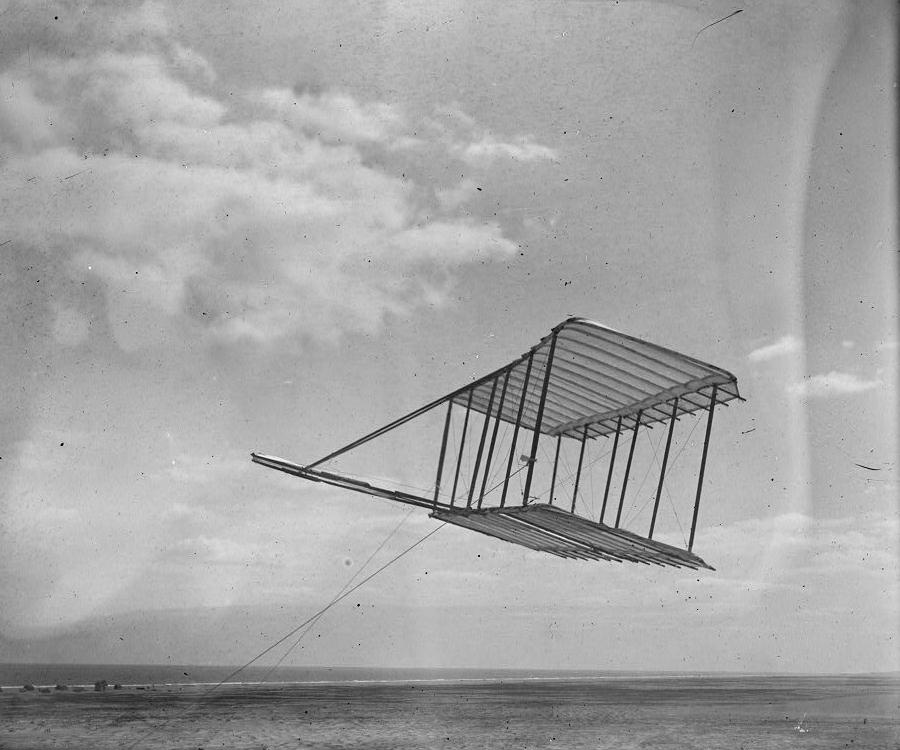
it produced inadequate lift, the Wrights mostly flew their first glider as a kite at Kitty
Hawk during October 1900. Sometimes loaded with 75 pounds of chains; sometimes with the
elevator in the rear, they mostly flew it with wing warp immobilized, although Wilbur
piloted it a few times (totaling about 2 minutes) to verify effectiveness of the wing
warping. There are also statements in letters written by the brothers
afterwards that the glider was flown with a tail (probably similar to the
fixed tail on a Chanute glider), and that they flew it with the pilot (Wilbur) not
just in the prone position, but also hanging beneath it like a Chanute or
Lilienthal glider. ecause
it produced inadequate lift, the Wrights mostly flew their first glider as a kite at Kitty
Hawk during October 1900. Sometimes loaded with 75 pounds of chains; sometimes with the
elevator in the rear, they mostly flew it with wing warp immobilized, although Wilbur
piloted it a few times (totaling about 2 minutes) to verify effectiveness of the wing
warping. There are also statements in letters written by the brothers
afterwards that the glider was flown with a tail (probably similar to the
fixed tail on a Chanute glider), and that they flew it with the pilot (Wilbur) not
just in the prone position, but also hanging beneath it like a Chanute or
Lilienthal glider. The 1900 Wright Glider specifications:
- 17 ft (5.2 m) wingspan
- 5 ft (1.5 m) chord
- 1/20 to 1/23 camber
- 4.8 ft (1.5 m) separation
- 165 sq ft (15.3 sq m) wing area
- 12 sq ft (1.1 sq m) front elevator area
- 11.5 ft (3.5 m) length
- 52 lbs (23.6 kg) weight.
The glider originally had a tail with fixed horizontal and
vertical surfaces, but this was eliminated sometime
during the Wright's flying experiments.
Despite its poor lift, the Wrights used three features of the 1900 glider on all their
subsequent aircraft: biplane wings, wing warp for roll control, and the flexible elevator.
They used the front elevator until the 1910 Model B, and the prone pilot position to
reduce air resistance until the 1907 Model A.
After the tests, the Wrights abandoned the glider at Kitty Hawk, NC. Tate family
salvaged it; used wing covering for daughter's dress.
See more images of the 1900 Wright Glider in our
Virtual Hangar.
References:
- McFarland, Marvin W. (ed) The papers of Wilbur and Orville Wright. McGraw-Hill Book Co.,
New York, 1953, pp 1183-1184, & plate 14, 16, 17.
- Kelly, Fred C. The Wright Brothers, a Biography. Harcourt, Brace and Co., New York,
1943, pp 35, 49, 54.
- Wright, Orville, "How We Invented the Airplane." (from depositions in
Montgomery vs. U.S. 13 Jan 20 and 2 Feb 21; in Kelly, Fred C. (editor) How We Invented the
Airplane, an Illustrated History. Dover Publications, New York, 1953, p 13-15)
[Submitted by Joe W. McDaniel]
|
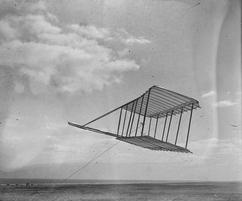
The 1900 Wright glider – Wilbur and Orville's first man-carrying airplane --
being flown as a kite.
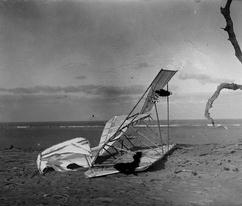
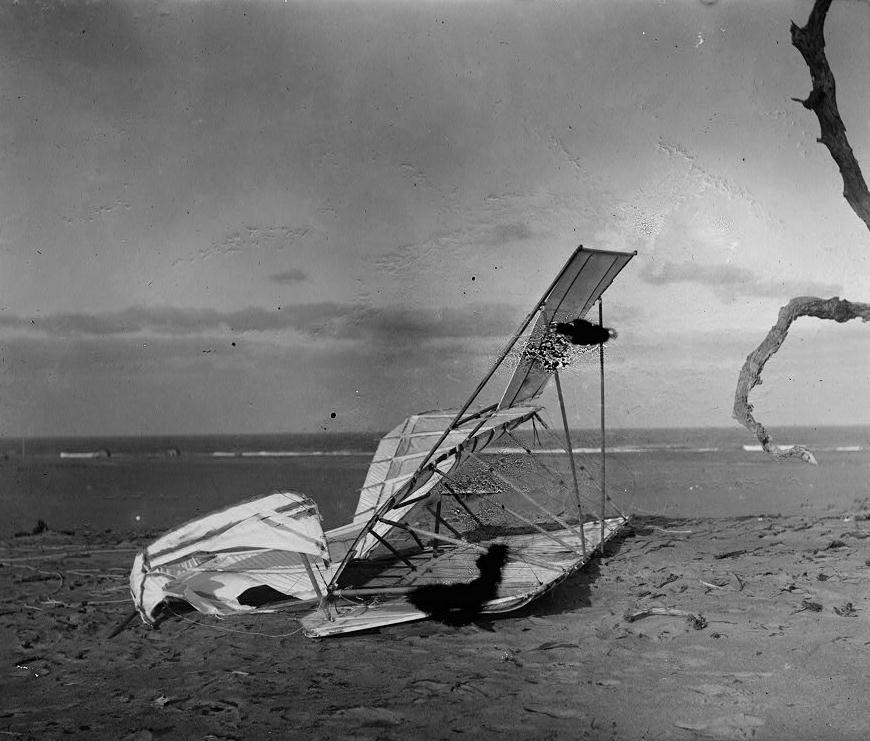
While the Wrights were testing their glider at Kitty Hawk, a gust of
wind picked it up off the sand a nearly dashed it to pieces.
Surprisingly, the Wright brothers were able to repair the damage and had
the glider flying again in a few days' time.
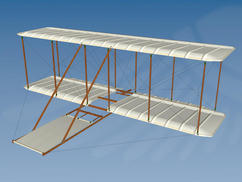
To explore the 1900 Wright glider in 3D, click the image above. |
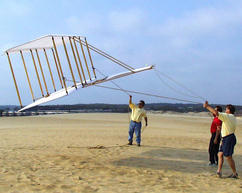
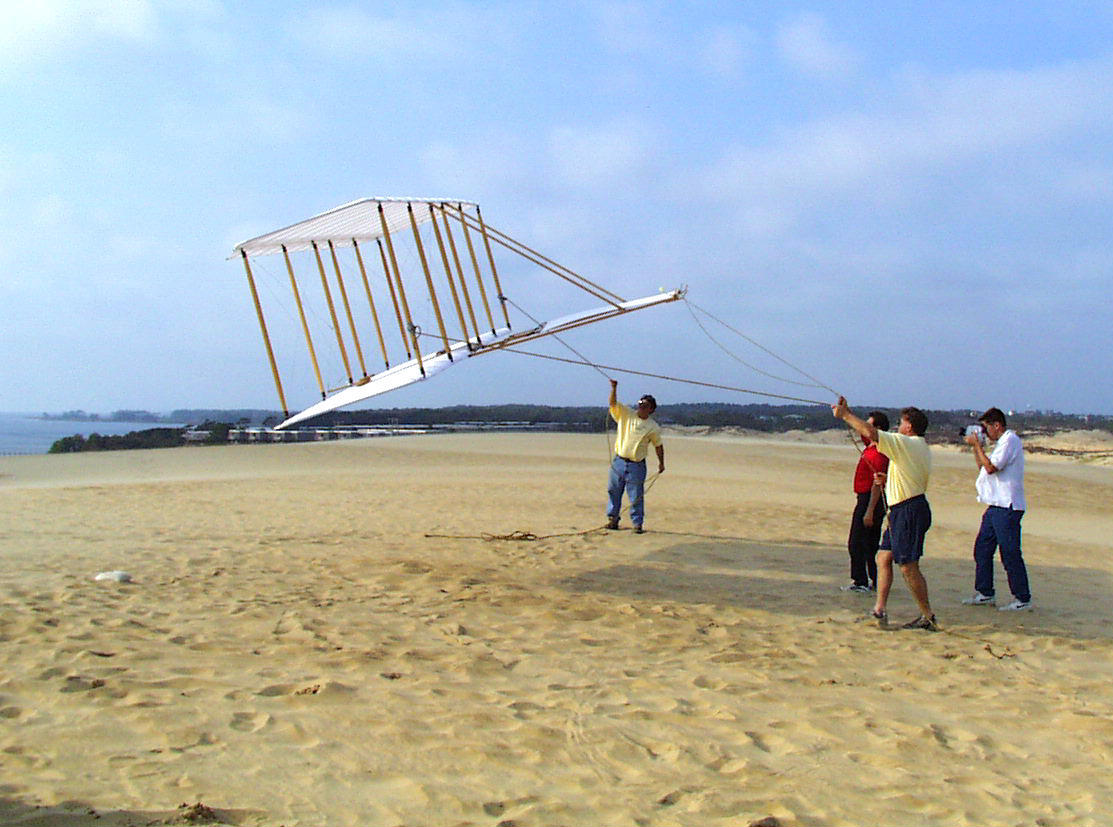
Compare the original glider to the
replica
we made and flew on the centennial anniversary of the Wright's first
gliding flights.
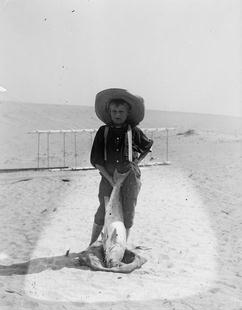
The Wrights took very few photos of their first manned aircraft at
Kitty Hawk. This image of a local boy, Tom Tate, showing the glider
in the background is the only other photo of the original 1900
Wright glider.
|